Home / Chest Workout at Home
Chest Workout at Home (No Equipment): 9 Push-Ups That Build Real Muscle
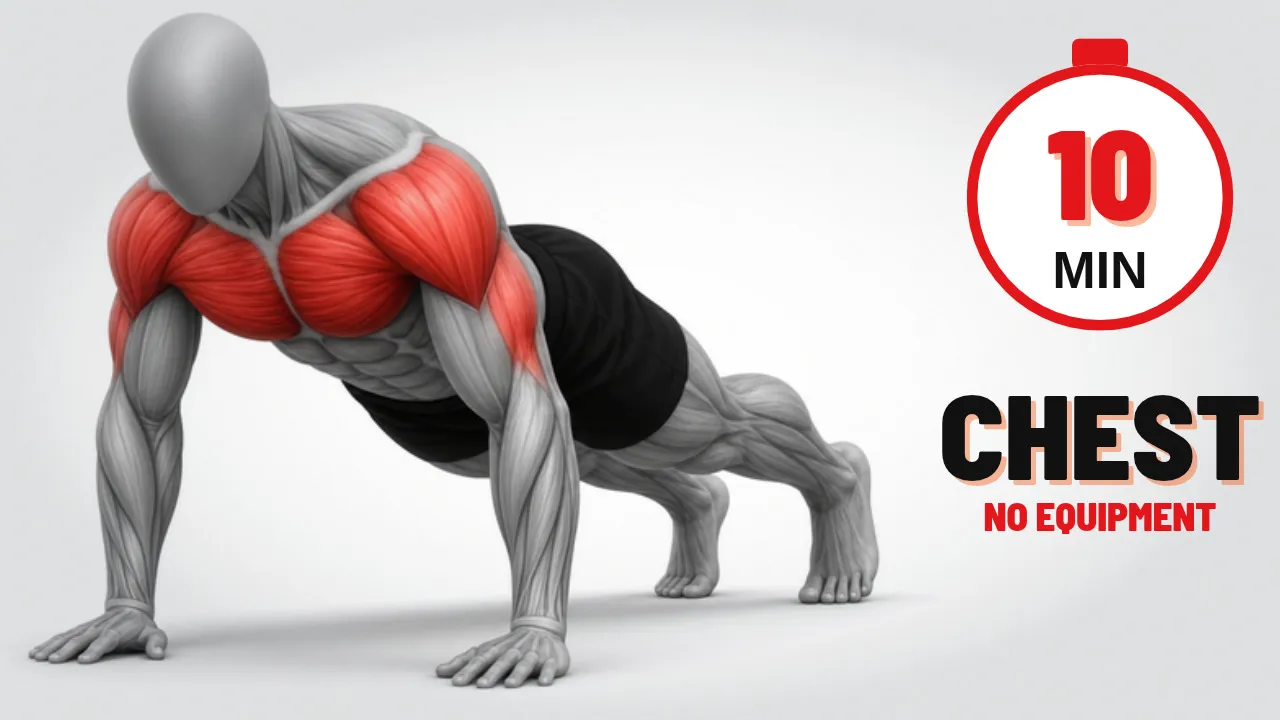
You do not need a bench, dumbbells or a gym membership to build your chest. A floor, a chair and a good plan are enough. This guide shows you the 9 push-up variations we use in our 10-minute follow-along workout, what each one trains, how to do it well, and how to keep progressing for months.
Short on time? Press play on the video below and follow along. Everything else on this page explains why the routine works and how to make it harder as you get stronger.
Can you really build your chest without equipment?
Yes. Your muscles respond to tension and effort, whatever creates it, and the research on this is clearer than most people expect.
In a 2017 study, Kikuchi and Nakazato had young men train either the bench press at a low load or push-ups, both taken close to failure, for eight weeks. Both groups gained a similar amount of chest and triceps muscle thickness and a similar amount of bench press strength. A 2015 study by Calatayud and colleagues found the same thing from a different angle: when push-ups and the bench press were set up to produce similar muscle activity, they produced similar strength gains over five weeks.
The bigger picture comes from a 2017 meta-analysis by Schoenfeld and colleagues. Light loads and heavy loads built a similar amount of muscle when sets were taken close to failure. Heavy loads were better for maximal strength, but for size the effort mattered more than the weight.
Push-ups only build muscle if they are hard for you. If you can do 50 easy reps, they mostly train endurance. The answer is harder variations, slower tempos and more volume, which is what the 9 exercises below give you.
The muscles a home chest workout trains
Every push-up variation in this guide trains the same three main muscles. Changing the angle and hand position changes how much work each one does.
Pectoralis major (your chest). This fan-shaped muscle has two main parts. The upper part (the clavicular head) attaches to your collarbone and works hardest when you press upward and forward. The larger lower part (the sternal head) attaches to your breastbone and does most of the work in flat and downward pressing.
Anterior deltoids (front of the shoulders). These help with every pressing movement and take on more of the load as the press angle moves overhead, which is why pike push-ups feel like a shoulder exercise.
Triceps (back of the upper arms). They straighten your elbows at the top of every rep. Narrow hand positions make them work harder.
Your core, especially your abdominals and glutes, also works the whole time to hold your body in a straight line. That is one advantage push-ups have over the bench press: they train the chest and core together.
The 9 push-ups, from easiest to hardest
The order below matches our video, and roughly matches the difficulty. Each move lists what it trains, how to do it, the most common mistake, and how to make it easier or harder.
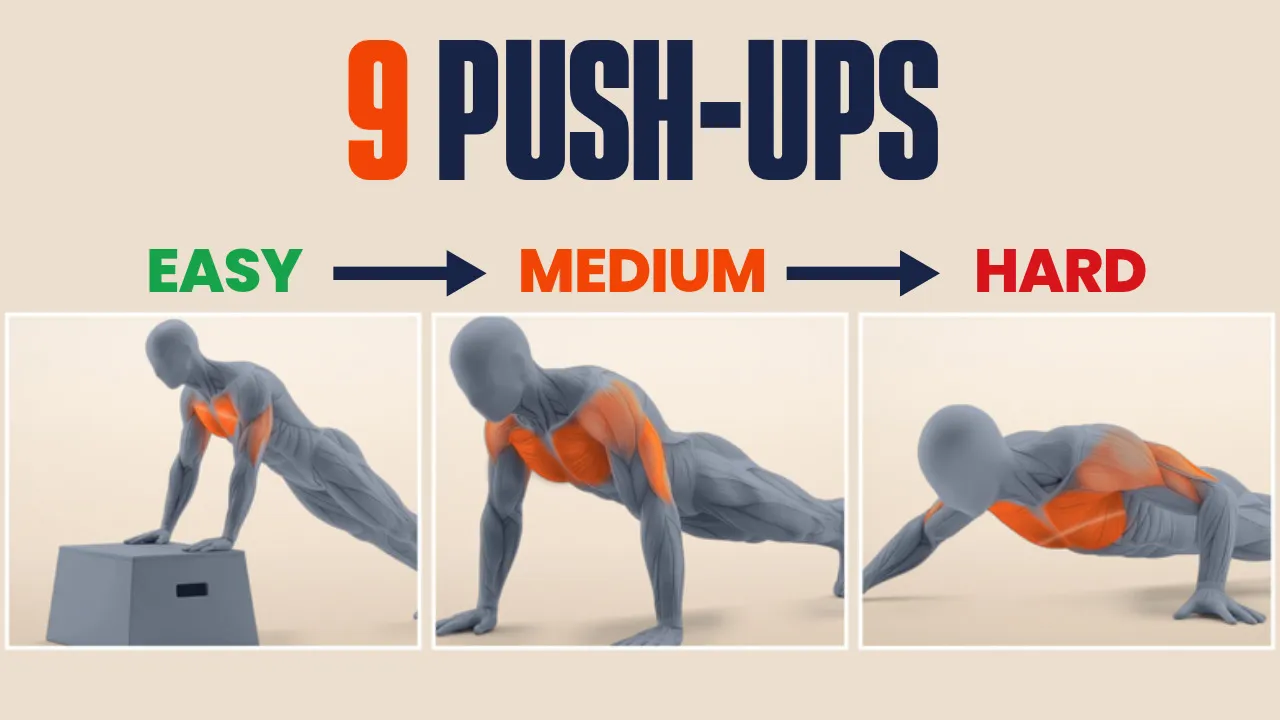
1. Incline push-up (hands on a chair or couch)
Trains: chest (with a bit more emphasis on the lower fibres), front shoulders, triceps.
How to do it: Place your hands slightly wider than your shoulders on a sturdy chair, couch or step. Walk your feet back until your body is a straight line from head to heels. Lower your chest to the edge of the surface, then press back up.
Why it works: Raising your hands reduces the share of your bodyweight you have to push. A 2011 study by Ebben and colleagues measured this directly: the higher your hands, the less of your bodyweight the movement loads, and the higher your feet, the more it loads. That makes the incline push-up the perfect starting point and a great warm-up.
Common mistake: letting the hips sag on the way down. Squeeze your glutes before every rep.
Easier or harder: use a higher surface to make it easier, a lower one to make it harder.
2. Standard push-up
Trains: the whole chest, front shoulders, triceps and core.
How to do it: Hands just outside shoulder width, fingers pointing forward. Keep your elbows at roughly 45 degrees from your body rather than flared straight out. Lower until your chest is a fist's width from the floor, then press up until your arms are straight.
Common mistake: cutting the range short. Half reps skip the stretched position at the bottom, where the chest is loaded hardest.
Easier or harder: drop to your knees, or slow the lowering phase to three seconds.
3. Wide push-up
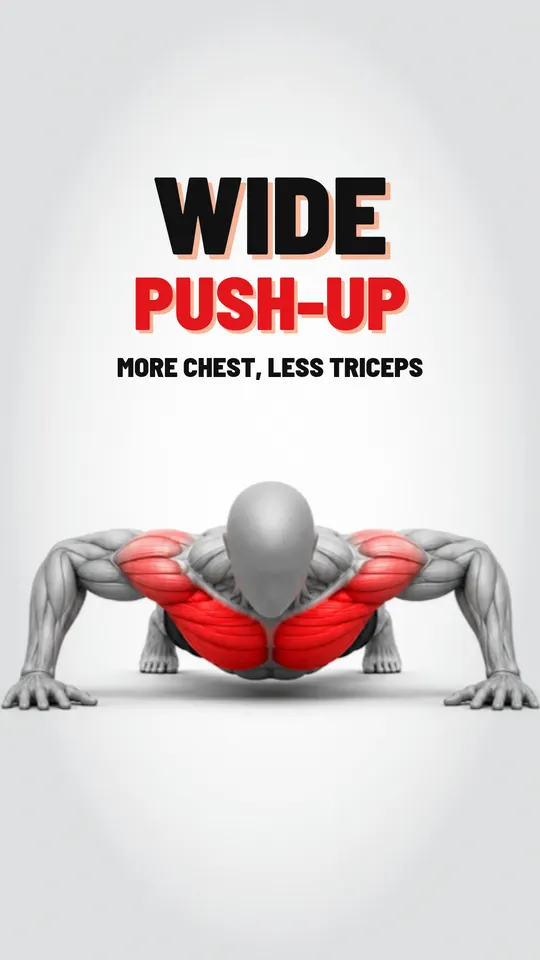
Trains: chest and front shoulders, with less work for the triceps.
How to do it: Set your hands about one and a half times shoulder width. Lower slowly under control and keep your shoulders away from your ears.
What the research says: Wider hands reduce how much the triceps contribute, because your elbows bend less. Studies comparing hand widths, including Cogley and colleagues in 2005, found that chest activity does not automatically go up with a wider grip, so think of the wide push-up as a way to shift work away from the arms rather than a special chest exercise. It is useful when your triceps are tired but your chest still has reps left.
Common mistake: going so wide that your shoulders hurt. If you feel a pinch at the front of the shoulder, bring your hands in.
4. Decline push-up (feet on a chair or couch)
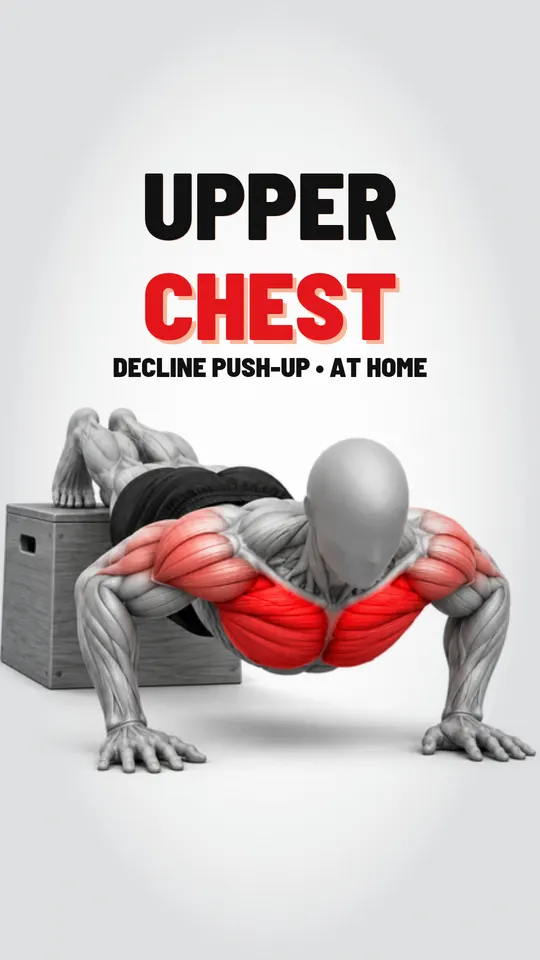
Trains: chest with more emphasis on the upper fibres, front shoulders, triceps.
How to do it: Put your feet on a chair or step and your hands on the floor. Keep your body straight from head to heels and lower your forehead toward the floor slightly in front of your hands.
Why it works: Elevating your feet does two things. It increases the share of your bodyweight you press, and it changes the press angle so it moves upward relative to your torso, which brings in more of the upper chest and the front shoulders. This is the closest bodyweight equivalent to an incline bench press.
Common mistake: piking the hips up to make it easier. Keep the line straight.
5. Elevated (deficit) push-up
Trains: chest through a longer range of motion.
How to do it: Put your hands on two stable supports of the same height, such as yoga blocks, thick books or two sturdy boxes. This lets your chest sink below the level of your hands at the bottom.
Why it works: The extra depth stretches the chest further under load. Training through a longer range of motion, especially the stretched part, has been linked to good muscle growth in recent research, so deficit push-ups are one of the best ways to make a standard push-up more effective without adding weight.
Common mistake: going deeper than your shoulders tolerate. Add depth gradually.
6. Archer push-up
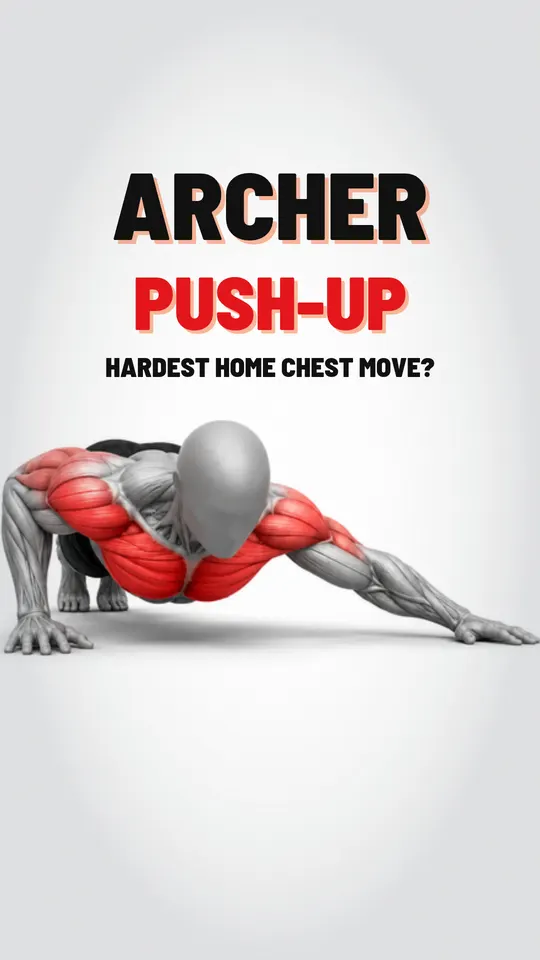
Trains: one side of the chest at a time, plus the shoulders and triceps.
How to do it: Start in a very wide push-up position. As you lower, shift your weight toward one hand and let the other arm straighten out to the side. Press back up, then alternate sides.
Why it works: Most of your bodyweight ends up on one arm, which roughly doubles the load on the working side compared with a standard push-up. It is the best stepping stone toward a one-arm push-up and one of the few bodyweight ways to make the chest work hard with low reps.
Common mistake: twisting the hips. Keep them square to the floor.
Easier: do it on an incline first.
7. Pike push-up
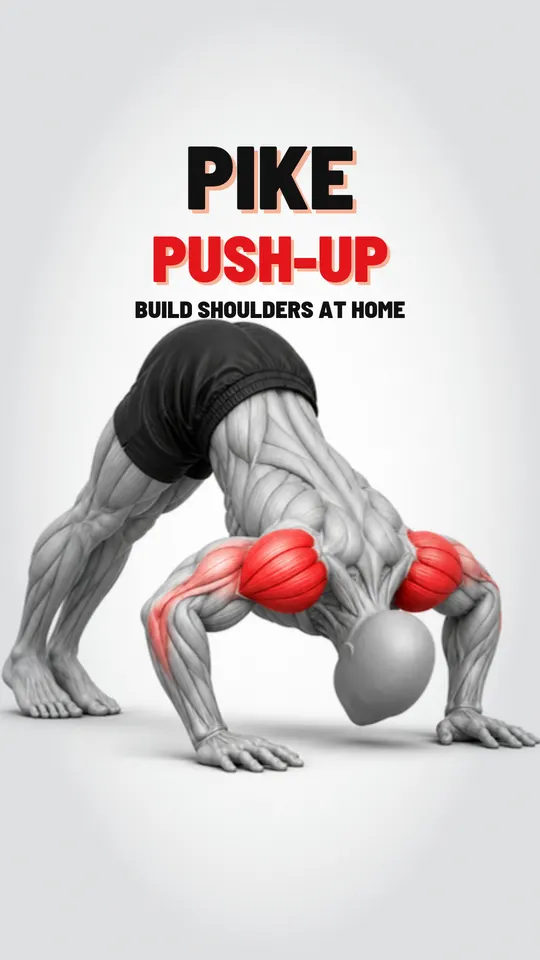
Trains: front shoulders and triceps, with the chest helping.
How to do it: Start in a push-up position and walk your feet in until your hips are high and your body forms an upside-down V. Bend your elbows and lower the top of your head toward the floor between your hands, then press back up.
Why it is in a chest workout: It mainly trains the shoulders and triceps that support your chest pressing, and it balances the routine. If shoulder strength is your weak point, this is the move that fixes it.
Common mistake: letting the elbows flare straight out. Keep them angled back.
8. Close-grip incline push-up
Trains: triceps, with the chest still working hard.
How to do it: Hands on a chair or step, close together under your chest. Keep your elbows close to your body as you lower.
Why it works: A narrow hand position makes your elbows bend more, which loads the triceps. Cogley's 2005 study found that a narrow hand position actually produced high chest activity too, so this move trains both. Doing it on an incline keeps it manageable late in the workout when you are tired.
Common mistake: letting the elbows drift out. Imagine brushing your ribs with your forearms.
9. Knee push-up (burnout)
Trains: chest, shoulders and triceps when they are already tired.
How to do it: Drop to your knees, keep a straight line from your knees to your head, and do as many clean reps as you can.
Why it is last: Knees shorten the lever and reduce the load, so you can keep doing quality reps after you can no longer do full push-ups. That pushes the set closer to failure, which is what makes light-load training work.
Which push-up variation should you choose?
Each variation shifts the work slightly. Use this table to pick the right one for your goal.
| Variation | Main target | Difficulty | Best for |
|---|---|---|---|
| Incline push-up | Chest, lower fibres | Easy | Beginners, warm-up |
| Knee push-up | Whole chest | Easy | Finishing sets, beginners |
| Standard push-up | Whole chest, core | Medium | Everyone |
| Wide push-up | Chest, less triceps | Medium | When triceps are tired |
| Close-grip push-up | Triceps and chest | Medium | Arm strength |
| Decline push-up | Upper chest, front shoulders | Hard | Upper chest focus |
| Deficit push-up | Chest in a deep stretch | Hard | More range of motion |
| Pike push-up | Shoulders, triceps | Hard | Shoulder strength |
| Archer push-up | One side of the chest | Very hard | Advanced progression |
Warm up before you start
Two minutes is enough. Do 20 arm circles in each direction, 10 slow incline push-ups on a chair, and 20 seconds in a high plank. Your shoulders should feel warm and loose before the first hard set.
The 10-minute follow-along workout
Our video puts all 9 exercises into one routine:
| Detail | Setting |
|---|---|
| Exercises | 9 push-up variations |
| Work / rest | 45 seconds work, 25 seconds rest |
| Total time | about 10 minutes |
| Equipment | none (a chair, couch or step helps) |
| Level | all levels, swap to knee push-ups any time |
The video shows a 3D muscle animation for every exercise, so you can see which part of your chest is working on each rep. There is no voiceover, so you can follow it anywhere and with your own music.
Watch the full workout on YouTube →
How often to do this chest workout
Muscle growth depends a lot on weekly training volume. A 2017 meta-analysis by Schoenfeld, Ogborn and Krieger found that more weekly sets per muscle led to more growth, with roughly ten or more hard sets per muscle per week doing better than fewer.
Every exercise in the routine counts as a hard set for your chest when you take it close to failure, so one session is about 9 sets. A simple plan:
| Level | Sessions per week | Notes |
|---|---|---|
| Beginner | 2 | Use incline and knee options freely |
| Intermediate | 2 to 3 | Do the full routine as shown |
| Advanced | 3 | Use the progressions below |
Leave at least one rest day between sessions. Soreness that lasts more than two days usually means you added too much too fast.
How to progress when it gets easy
A bodyweight routine stops working when it stops being hard. Change one thing at a time, every week or two:
- More reps in the same 45 seconds. Track your numbers and try to beat them.
- Slower lowering. Take three to four seconds to lower each rep. It makes the same push-up much harder.
- A pause at the bottom. Hold one second with your chest just off the floor.
- Harder variations. Swap incline for standard, standard for decline, decline for archer.
- Add a deficit. Use books or blocks under your hands to increase the range of motion.
- Run the routine twice. For advanced trainees, two rounds back to back doubles the weekly volume.
A 4-week plan to build your chest at home
| Week | Sessions | What to do |
|---|---|---|
| 1 | 2 | Follow the video, use easier options whenever form breaks down |
| 2 | 2 | Same routine, try to beat your rep count on every exercise |
| 3 | 3 | Add a third session, use a 3-second lowering phase on push-ups |
| 4 | 3 | Swap in harder variations: decline for standard, archer for wide |
After week 4, keep adding difficulty with the progression list above, or run the routine twice back to back.
Common mistakes that hold people back
Stopping far from failure. Most people end a set when it gets uncomfortable, not when it gets hard. With bodyweight training you need to finish within a few reps of failure.
Flaring the elbows. Elbows straight out to the sides at 90 degrees puts stress on the front of the shoulder. About 45 degrees is easier on the joints for most people.
Sagging or piking hips. A push-up is a moving plank. If your hips drop or rise, your core is not doing its job and the chest gets less of the work.
Skipping the bottom of the rep. The stretched position is where the chest is loaded most. Full range beats more half reps.
Doing the same routine forever. If you have done the same number of reps for a month, change one of the progression variables above.
Frequently asked questions
Can push-ups build muscle without weights?
Yes. Studies have found push-ups and the bench press build similar amounts of muscle when both are taken close to failure. The key is to keep them challenging by using harder variations as you get stronger.
How many push-ups should I do a day to build my chest?
Daily push-ups are not necessary. Two to three hard sessions per week with about 9 to 12 sets each, taken close to failure, is a better plan for growth than doing a few easy sets every day.
Which push-up works the upper chest?
The decline push-up, with your feet raised on a chair or step. It changes the angle of the press and loads more of your bodyweight.
Is this workout good for beginners?
Yes. Start with the incline and knee versions of each move and stay at the easier options until you can do 10 or more clean reps.
Will this workout give me a bigger chest without a gym?
It can, if you train consistently, progress the difficulty over time, and eat enough protein and calories to support muscle growth.
How long until I see results?
Most people notice strength improvements within two to four weeks. Visible muscle growth usually takes eight weeks or more of consistent training.
Key takeaways
- Push-ups can build as much chest muscle as light bench pressing when you take sets close to failure.
- Train your chest 2 to 3 times per week with about 9 to 12 hard sets per week.
- Decline push-ups target the upper chest, incline push-ups are the easiest starting point.
- Make it harder over time with slower reps, pauses, deficits and harder variations.
- Follow the free 10-minute 3D video workout to put it all together.
Start now
Press play, follow the 3D muscle animation, and do the full 10 minutes. Save this page so you can come back to the progression plan when the routine gets easy.
Sources
- Kikuchi N, Nakazato K. Low-load bench press and push-up induce similar muscle hypertrophy and strength gain. Journal of Exercise Science and Fitness. 2017;15(1):37-42.
- Calatayud J, et al. Bench press and push-up at comparable levels of muscle activity results in similar strength gains. Journal of Strength and Conditioning Research. 2015;29(1):246-253.
- Schoenfeld BJ, Grgic J, Ogborn D, Krieger JW. Strength and hypertrophy adaptations between low- vs. high-load resistance training: a systematic review and meta-analysis. Journal of Strength and Conditioning Research. 2017;31(12):3508-3523.
- Schoenfeld BJ, Ogborn D, Krieger JW. Dose-response relationship between weekly resistance training volume and increases in muscle mass. Journal of Sports Sciences. 2017;35(11):1073-1082.
- Ebben WP, et al. Kinetic analysis of several variations of push-ups. Journal of Strength and Conditioning Research. 2011;25(10):2891-2894.
- Cogley RM, et al. Comparison of muscle activation using various hand positions during the push-up exercise. Journal of Strength and Conditioning Research. 2005;19(3):628-633.